3/3/12: How Much Condo Can You Really Afford in Singapore?
Daniel Wu | CEA Reg No R070500C | OrangeTee & Tie Pte Ltd, Estate Agent Licence No. L3009250K | +65 9114 1924
General information only, November 2026, not financial advice.
My mission is not to sell you a condo. It is to help you borrow prudently, inside Singapore's strict rules, so you can upgrade and still live well afterwards.
Singapore already has strict rules for a reason. The Monetary Authority of Singapore (MAS) caps your total debt at 55% of income under TDSR, caps housing instalments at 30% of income under MSR for HDB flats and ECs whose MOP has not expired, and banks must test a bank loan at 4% even if the actual rate is lower (HDB loans are tested at 3%). Those rules are there to protect you. My job is to show you, with real data, what those rules mean for you — before you fall in love with a showflat.
The old textbook rule — price should be 5x your annual income — does not work in Singapore. I tested it against official Singapore data, and it fails for a median household buying a median condo. So I built a Singapore framework instead: 3/3/12.
Why does 5x income not work in Singapore?
Because Singapore prices and Singapore incomes do not fit that rule.
Median monthly household market income in 2025 was $12,446. That is $149,352 a year. The 2025 figures are preliminary. Market income is income before government transfers and taxes, from employment and non-employment sources.
Median condo resale in September 2026 was $1,710,000 at $1,712 psf, across 1,126 resale caveats. Median new-launch psf was $2,440. Median HDB resale was $555,000.
Source: PLB Research market tiles, September 2026, from URA resale caveats, URA developer sales and HDB resale data on data.gov.sg, feed checked 30 Oct 2026. Condo figures are resale caveats only, no new sales or sub-sales.
Work it out for a median household:
Annual income: $12,446 × 12 = $149,352
5x income: $149,352 × 5 = $746,760
Median resale condo: $1,710,000 ÷ $149,352 = 11.4x income (11.45x to two decimals)
A new-launch 2-bed at about 800 sq ft × $2,440 psf ≈ $1,952,000 ÷ $149,352 = 13.1x income — illustrative only, not a median price, because the new-launch median is a psf, not a price
$746,760 is barely above a median HDB flat at $555,000, and less than half a median resale condo. A median household following 5x could not buy a median condo. That is not because the household is doing something wrong. It is because 5x was never a Singapore rule.
Other published benchmarks say the same thing, with different methods and years — do not mix them into one number. DBS Research, cited in a February 2026 blog, put the average private price-to-income ratio at 13.4x between 2000 and 2023 — secondary citation, not a DBS primary source I have checked. A 2023 Urban Land Institute study, reported by CNA, put the median private home at 13.7x median household income, and HDB flats at 4.7x. The Urban Land Institute Asia Pacific Home Attainability Index 2026, via a Cashew summary, put HDB at 4.3x median household income. These are supporting context only. The 12x in 3/3/12 comes from the SingStat / PLB September 2026 figures above, not from these benchmarks.
So the honest question is not "why can't you meet 5x?" It is "what is the real Singapore multiple, and how do you borrow prudently inside it?"
Where did 3/3/5 come from?
3/3/5 is not a government rule, and it is not a bank rule. That matters, because a lot of articles present it as if it were.
It was created by Vina Ip, known as Property Soul, a Singapore property blogger and investor. She set it out in her 2014 book, No B.S. Guide to Property Investment, and has written about it since.
Vina Ip herself writes on propertysoul.com: "In 2014, I came up with the 3-3-5 rule as a guideline to check a property's affordability" and "Even after the CPF Board endorsed my 3-3-5 rule, many still criticize it as too conservative." That endorsement claim is her claim. I have not found a CPF or MAS page that publishes the full 3-3-5 rule as its own rule, and I will not present it as one.
What CPF does publish, in its own words, is close — but not the same. In "Essential budgeting tips for your BTO flat", CPF Board, 6 Mar 2026, CPF gives three guidelines for a BTO purchase: (i) keep your Mortgage Servicing Ratio to 25% of gross monthly income, (ii) ensure monthly instalments are less than your monthly OA contributions, and (iii) choose a flat priced under five times your combined annual income. That is CPF's budgeting advice for a BTO flat, not an endorsement of the full 3-3-5 rule, and its MSR figure is 25%, not 30%.
What MAS does publish, as law / regulation, is different again: TDSR 55%, MSR 30% for HDB flats and new ECs, LTV 75% for a first loan, and a 4% stress test for bank loans. Those are the strict rules in place. 3/3/5 is a prudent rule of thumb that sits inside those rules — its 30% instalment matches MSR 30%, its 30% down is stricter than the 25% legal minimum — but its 5x price cap is not a MAS or CPF rule.
In one line: 3/3/5 came from Property Soul in 2014, not from MAS, CPF or a bank. The first two parts line up with Singapore's real rules. The 5x part does not — and that is why I tested it against Singapore data, and why I am replacing it with 12x.
Source: Propwise, How Much Property Can You Afford in Singapore? The 3/3/5 Rule (2026); Property Soul, propertysoul.com; DollarsAndSense, 3-3-5 Rule Of Buying An HDB Flat; CPF Board, Essential budgeting tips for your BTO flat, 6 Mar 2026; MAS, Calculating TDSR thresholds.
What is 3/3/12?
3/3/12 is three checks, in order. The first two are about how you pay. The third is about the price you aim at, compared with Singapore data.
3 — 30% downpayment
Put down 30% of the price, in cash + CPF. The legal minimum is 25% for a first loan — loan-to-value (LTV) 75%, with at least 5% in cash. 30% is the comfortable target, not the minimum. It leaves you with a smaller loan, a lower instalment, and room if rates rise.
Source: MAS, TDSR / LTV rules. LTV 75% for a first housing loan.
3 — Instalment within one-third of income
Your monthly housing instalment should be within one-third of your gross monthly income, tested at 4% over 30 years. This is my advice, not a MAS rule — but it is close to a real MAS rule, and that is the point.
MAS has two caps. TDSR caps all your debt at 55% of income, for every bank property loan. MSR is stricter: it caps the housing instalment alone at 30% of income, and MAS applies it to HDB flats and ECs whose MOP has not expired. One-third is 33.3%, so MSR at 30% is actually slightly stricter than one-third — they are the same idea, in the same range. TDSR at 55% is the looser bank maximum. MSR is a regulatory cap, not advice — the government does not advocate a one-third rule — but one-third sits just beside that stricter cap.
That is why I use one-third as my advice, for every buyer, including private condo buyers who are not covered by MSR. It keeps you close to the stricter MSR line, even when the law would let you borrow more under TDSR alone.
Source: MAS, TDSR 55%, MSR 30%, stress test 4% for bank loans / 3% for HDB loans — MAS Notice 645, last revised 21 Aug 2025. Note: TDSR also applies a 30% haircut to variable income and rental income, and LTV falls to 55% if tenure exceeds 30 years (25 for HDB) or runs past age 65 — so your own bank cap may be lower than the headline figures here.
12 — Price within 12x annual household income
Aim for a price within 12 times your annual household income. 12x is the Singapore median, not a textbook ideal. A median household at $12,446 a month earns $149,352 a year. 12x that is $1,792,224 — right in the median resale condo range. A household at $12,000 a month earns $144,000 a year. 12x that is $1,728,000.
Source: SingStat median household market income 2025, $12,446 a month; PLB Research / URA caveats, median condo resale September 2026, $1,710,000.
12x is a target to work towards, not a pass/fail. If you are above 12x, it does not mean you cannot buy. It means you need more downpayment, a lower price, or more time to save — and you should check the loan, not just the price.
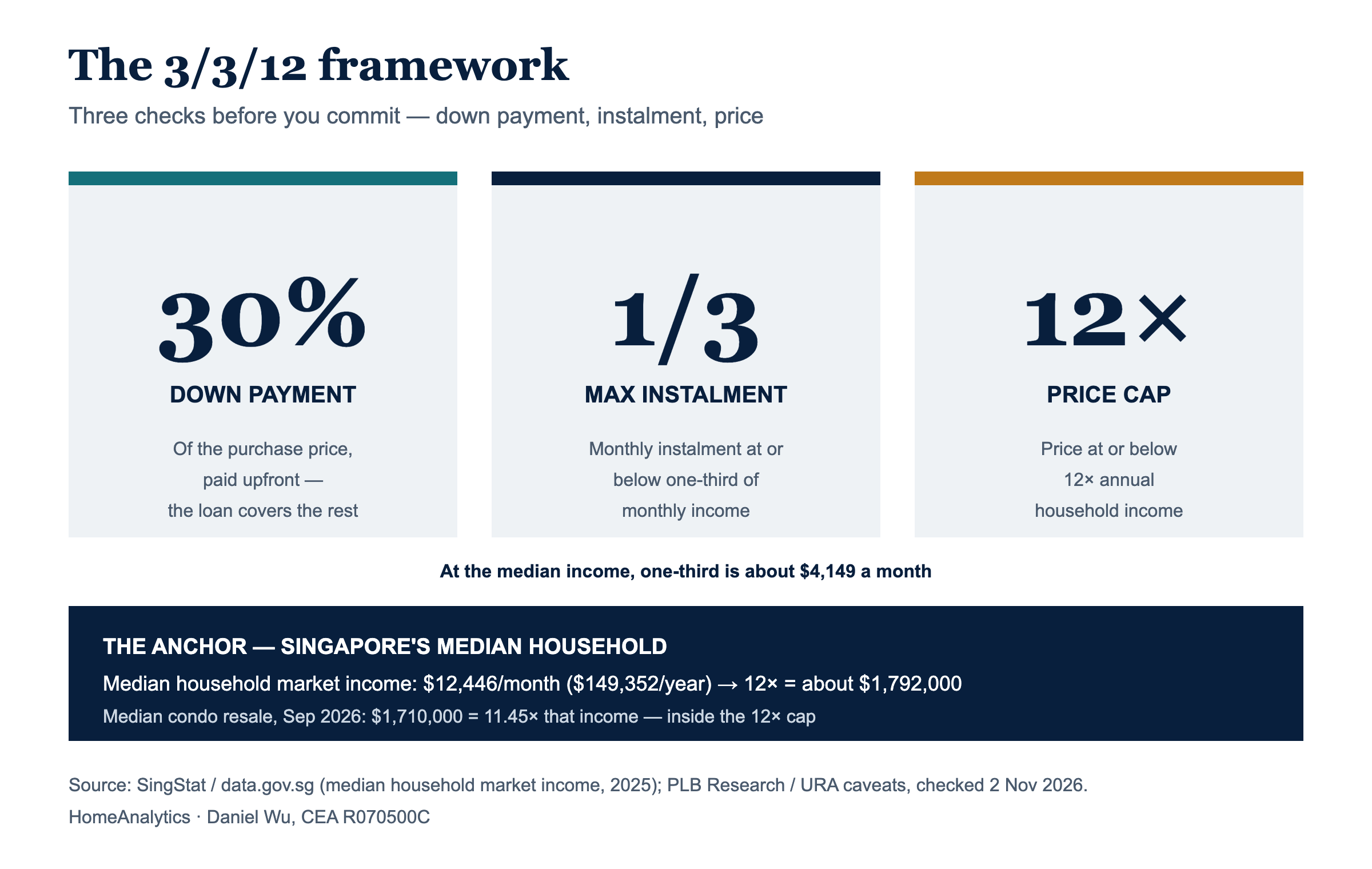
The 3/3/12 framework: 30% down, instalment at or below one-third of income, price at or below 12× annual income. At the median household income of $12,446/month (SingStat, 2025) the cap is about $1,792,000 — the median condo resale in Sep 2026 was $1,710,000, or 11.45×. Sources: SingStat / data.gov.sg; PLB Research / URA caveats, checked 2 Nov 2026.
How do I use 3/3/12? Worked example
Take a household earning $12,000 a month. That is $144,000 a year.
Step 1 — 12x price
$144,000 × 12 = $1,728,000. That is the price to aim at. A median resale condo at $1,710,000 is inside it. A new-launch 2-bed at about $1,950,000 is above it — 13.6x income.
Step 2 — 30% down
30% of $1,728,000 = $518,400. That is cash + CPF. If you have less than that, your loan is bigger, and your instalment is higher. That is where your HDB sale proceeds matter — see the next question.
Step 3 — One-third instalment, tested at 4%
One-third of $12,000 = $4,000 a month. At 4% over 30 years, $4,000 a month supports a loan of about $838,000. With a 30% downpayment, that loan + downpayment gives a price of about $1,197,000 — lower than the 12x price above. That gap is the point. The price check and the instalment check are two different checks, and the lower one is the one that binds.
For comparison, TDSR alone would allow $6,600 a month ($12,000 × 55%), supporting a loan of about $1,383,000 at the same 4% test. That is the bank maximum. One-third is the comfortable level. You decide where between the two you want to sit — I will show you both, and I will not hide the comfortable one.
Use the calculator on this site — Calculator — to run your own numbers. It shows TDSR first, then the one-third advice, then how close you are to 3/3/12.
Why does price ÷ income overstate the burden for an upgrader?
Because an upgrader is not paying the full price from income alone. You are paying it from three things: your HDB sale proceeds, your CPF, and your income.
That is why the calculator starts with Step 1: what will you walk away with when you sell?
Selling price − outstanding loan − selling costs = total proceeds
Total proceeds = CPF refund + cash in hand
CPF refund = CPF OA used + accrued interest at 2.5% a year
Illustrative example, labelled as such: sell $675,000, outstanding loan $200,000, CPF used $150,000 for 5 years, selling costs $16,000.
Accrued interest ≈ $150,000 × [(1.025)^5 − 1] ≈ $19,700. CPF refund ≈ $169,700.
Total proceeds = $675,000 − $200,000 − $16,000 = $459,000.
Split: $169,700 back to CPF OA + $289,300 cash in hand.
That $459,000 — not $675,000, and not a "profit" — is what feeds your downpayment. CPF does not publish a refund formula; the figure above is an estimate only, assuming the full $150,000 was used in one lump sum at the start of the 5 years. In real life CPF is used in stages, interest is computed monthly and compounded annually, and grants used are also refunded with interest — so check your exact refund on cpf.gov.sg. Selling costs in the example are $16,000 and assume no SSD and no resale levy apply. If they do, they come off the proceeds too. Check your exact outstanding loan on your latest bank / HDB statement. The calculator estimates it; your statement is the real number.
Source: CPF Board, CPF OA use and accrued interest 2.5% a year; HDB resale data on data.gov.sg.
For an upgrader, the more honest second check is loan ÷ income, not price ÷ income:
$12,000 income, $838,000 one-third loan = 5.8x loan-to-income
$12,000 income, $1,383,000 TDSR loan = 9.6x loan-to-income
Why does MSR make upgrading so hard at today's prices?
Because MSR, not TDSR, is the binding cap for a new EC or an HDB flat — and MSR is 30%, tested at 4%.
Work it out, at 4% over 30 years:
$12,000 income: MSR cap $3,600 a month. Loan ≈ $754,000. At LTV 75%, price ≈ $1,005,000.
$16,000 income — the EC income ceiling for most ECs in 2026: MSR cap $4,800 a month. Loan ≈ $1,005,000. Price ≈ $1,340,000.
$18,000 income — the EC income ceiling for tenders closing on or after 24 Aug 2026: MSR cap $5,400 a month. Loan ≈ $1,131,000. Price ≈ $1,508,000.
Now compare that with today's price quantum. Median condo resale in September 2026 was $1,710,000. A new-launch 2-bed at about 800 sq ft × $2,440 psf is about $1,952,000. Even a household at the $18,000 EC ceiling cannot reach a median resale condo on MSR alone, without a large downpayment from sale proceeds and CPF.
That is the point. MSR is doing its job — it is meant to be strict — but at today's prices it makes a straight income-only upgrade to a new EC or HDB very hard. That is why most upgraders cannot buy on income alone. They buy on income + sale proceeds + CPF. And that is why a resale private condo, which is governed by TDSR 55% only, not MSR, looks more possible on paper: at $12,000 income, TDSR allows $6,600 a month, a loan of about $1,383,000, a price of about $1,844,000 at LTV 75%. More possible — but $6,600 a month is 55% of income, before car, food, and family. That is the bank maximum, not a comfortable life.
So the honest answer is not "you cannot upgrade". It is "you cannot upgrade on income alone at today's prices, under MSR. You need proceeds, CPF, and time — or a smaller unit, or a resale unit where TDSR applies, with your eyes open about the instalment."
Source: MAS, TDSR 55%, MSR 30%, stress test 4%, LTV 75%; SingStat median income 2025; PLB Research / URA caveats, median condo resale September 2026, $1,710,000.
What does prudent borrowing look like, inside Singapore's rules?
Prudent borrowing is not borrowing the maximum. It is borrowing an amount you can still pay if rates rise, if income dips, or if you need to sell in a soft market.
Singapore's rules already push you that way:
TDSR 55%: total monthly debt, including housing, car, student and credit card debt, cannot exceed 55% of gross monthly income. Source: MAS.
MSR 30%: housing instalment cannot exceed 30% of gross monthly income for HDB flats and ECs whose MOP has not expired. Source: MAS.
Stress test 4%: banks must test a bank loan at 4% for private property, even if the actual rate is lower; HDB loans are tested at 3%. Source: MAS.
LTV 75%: first bank loan can be at most 75% of the price or valuation, whichever is lower, with at least 5% in cash. LTV falls to 55%, with 10% cash, if tenure exceeds 30 years (25 for HDB) or runs past age 65. Second and later loans are lower again. Source: MAS.
SSD: Seller's Stamp Duty, 16% / 12% / 8% / 4% in years 1–4 for homes bought on or after 4 July 2025, 0% after. If you sell early, you pay. That is why an exit plan matters. Source: IRAS, Seller's Stamp Duty for residential property.
My advice, on top of those rules:
Keep the instalment within one-third of income, tested at 4% for a bank loan (3% for an HDB loan).
Keep 6–12 months of instalments in cash after you buy, separate from CPF. CPF OA can be used to pay monthly housing instalments, but OA contributions depend on your employment income — so a cash buffer is what protects you if income falls.
Do not use the 5x rule to decide. Use 12x as the Singapore price check, and the loan check above as the instalment check.
If the numbers say "not yet", that is a valid answer. Sometimes the right advice is to wait, save more, or buy a smaller unit — and I will say so.
How was 3/3/12 built?
This framework was built from official Singapore data, not from a textbook or from another agent's rule.
Income — SingStat
Median monthly household market income 2025, $12,446, from SingStat Key Household Income Trends 2025, released 9 Feb 2026. 2025 figures are preliminary. From 2025, SingStat's headline is market income — income from employment and non-employment sources, before government transfers and taxes, for all resident households. Why median, not average: the average (mean) monthly household market income in 2025 was $16,159, higher than the median $12,446, because a small number of high-income households pull the average up. The median is the middle household.
Prices — HDB and URA, via data.gov.sg
Median HDB resale in September 2026 was $555,000. Median condo resale in September 2026 was $1,710,000 at $1,712 psf, across 1,126 resale caveats, from PLB Research market tiles, URA caveats compiled by PLB. Median new-launch psf was $2,440, from URA developer sales. Why medians, not averages: a median is the middle deal. An average is pulled up by a few very expensive deals. Medians are also from different populations — new launch and resale are different homes — so the gap between them is not a like-for-like premium.
Rules — MAS, IRAS, CPF, HDB
TDSR 55%, MSR 30%, stress test 4%, LTV 75%: MAS, Calculating TDSR thresholds. SSD: IRAS, Seller's Stamp Duty for residential property. CPF accrued interest 2.5% a year: CPF Board. Resale levy $15,000–$55,000 applies only for a second subsidised flat or new EC, not for a private condo.
Limits — read this before you use the framework
One month is a snapshot, not a trend. September 2026 medians move month to month. Re-check the latest month before you cite a figure again.
Medians tell you nothing about one block, one stack, or one floor. Your own flat or condo could be well above or below the median.
Household income in the 2025 SingStat headline includes employer CPF and non-employment income, and covers all resident households. Your own household income may be employment income only. Use your own payslip / CPF income, not the median, in the calculator.
The calculator on this site is indicative only. It is not a loan approval, a valuation, or financial advice. Banks test your actual income, debts, age and the property.
What to do next
Run your numbers on the calculator: Calculator — TDSR first, one-third advice second, 3/3/12 progress third.
If you want me to run your real numbers with you, book a free consultation: Consultation. Bring your latest payslip, CPF statement, and outstanding loan statement, and I will work through your sale proceeds, your downpayment, and your instalment with you — and tell you plainly if the answer is "not yet".