Plan Your Exit Before You Buy: Exit Strategy + Ballot Choice in Singapore
By Daniel Wu, CEA Reg No: R070500C | Updated November 2026

Most buyers ask: "Can I afford this? Is it a good deal?"
Almost no one asks: "Who will buy this from me in 5–10 years, and at what price?"
That second question is your exit strategy. If you cannot answer it, you are not buying an asset — you are buying a hope.
Plan the exit in 5 checks, before you buy:
How long must I hold it?
Who will buy it next?
What is the lease left?
What is coming up nearby?
Can I afford to hold it if I cannot sell it when I want to?
1. The 5 exit factors — run these before you buy
Holding period. How long will you actually hold it? A new launch takes 3–4 years to TOP, then you need to hold past SSD. An EC takes 5 years MOP from TOP, then 10 years to full privatisation. If your plan is "sell at TOP in 12 months", SSD will eat it — see Section 2.
Buyer demand. Who is the next buyer? A family needing 3 beds, a couple needing 2 beds, an investor needing rent, a downgrader needing one level? A 2-bedder with a bad layout has a smaller buyer pool than a 3-bedder with a good layout, even at the same psf.
Tenure. Fresh 99 years, or 60 years left? A buyer in 10 years will pay less for a shorter lease, and a bank will lend less on it. Freehold is not automatically better — entry price and location matter more — but lease left is always part of the exit price.
Market trends. What is the upcoming supply in that area? New GLS sites, new launches, BTOs, MRT lines? A view today can be blocked by the next GLS site. A new launch next door can undercut your resale price in 5 years.
Financial flexibility. Can you hold it if you cannot sell it when you want to? Can you pay the mortgage at 4%, not 2%, for 6–12 months if one income stops? If you must sell in a down market, you will sell at a loss. Flexibility is the exit.
If a home fails 2 or more of these 5, do not buy it hoping the market will fix it. The market does not fix a bad layout, a short lease, or a flood of new supply next door.
2. Your exit clocks — SSD, MOP, and how long you are locked in
These are the clocks that decide when you can sell without a penalty. They are different for HDB, EC, and private condo. Do not mix them up.
Seller's Stamp Duty (SSD), private homes: for homes bought on or after 4 July 2025, SSD applies for 4 years — 16% in year 1, 12% in year 2, 8% in year 3, 4% in year 4, 0% after 4 years. Charged on the higher of sale price or market value.
Source: IRAS, SSD rates effective 4 July 2025, IRAS page last updated 13 Aug 2026.
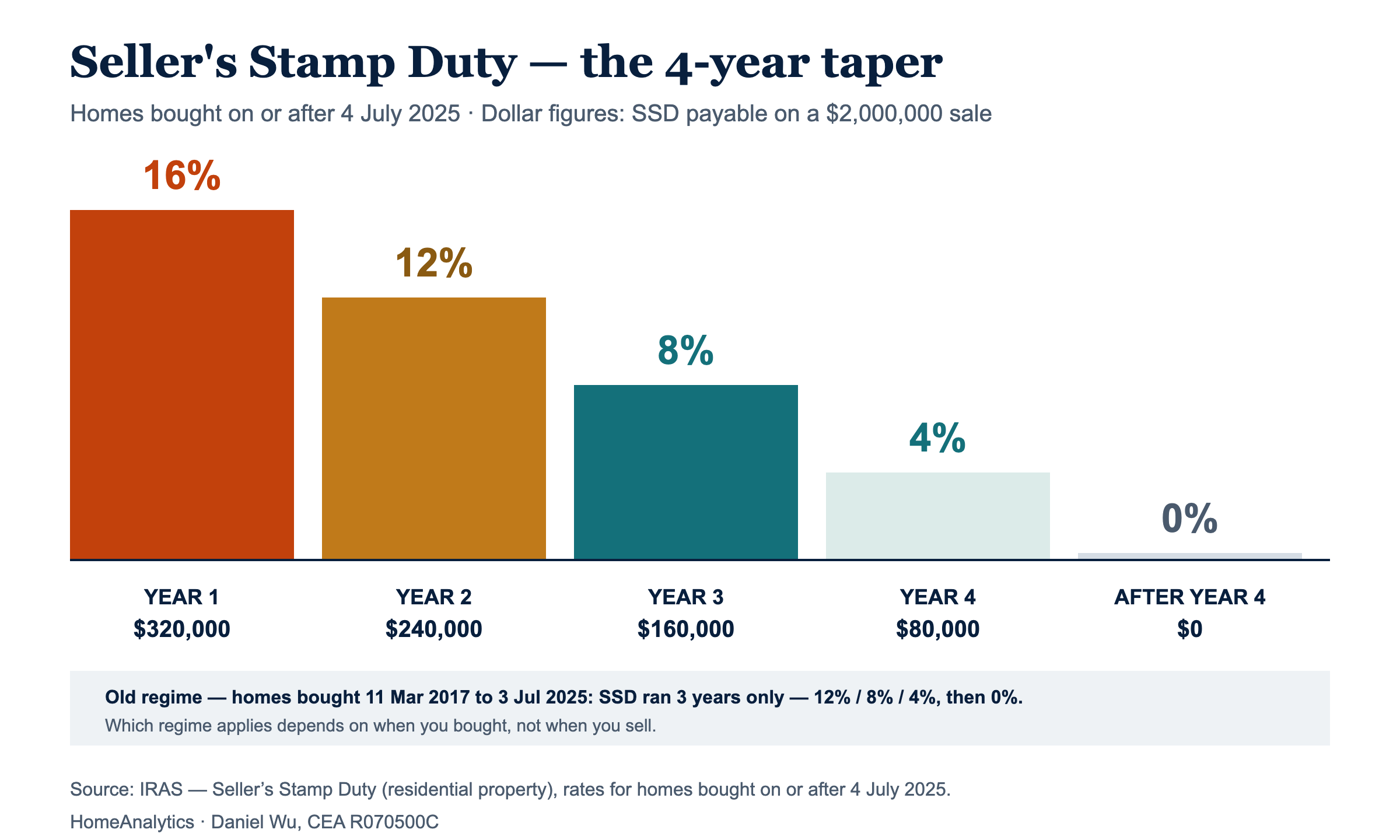
Seller's Stamp Duty for homes bought on or after 4 Jul 2025 tapers over 4 years: 16% / 12% / 8% / 4%, then 0% — $320,000 down to $0 on a $2,000,000 sale. Source: IRAS. Bought between 11 Mar 2017 and 3 Jul 2025? The old 3-year SSD (12% / 8% / 4%) applies instead.
On a $2m sale: year 1 SSD is $320,000, year 2 is $240,000, year 3 is $160,000, year 4 is $80,000. That is why a short flip does not work. Illustrative, my own arithmetic from the IRAS rates.
For homes bought 11 Mar 2017 to 3 July 2025, the old 3-year rule applies: 12%, 8%, 4%. Source: IRAS.
SSD clock starts on purchase — OTP acceptance or Sale and Purchase Agreement, whichever is earlier — not on TOP or key collection.
HDB MOP: 5 years for Standard flats, 10 years for Plus and Prime flats, from key collection / possession. You cannot sell, rent out the whole flat, or buy private property during MOP.
EC MOP: 5 years from TOP for ECs on land tendered before 8 May 2026, 10 years from TOP for ECs on land tendered on or after 8 May 2026. Fully privatised after 10 years (old rules) or 15 years (new rules).
Source: MND, 8 May 2026; HDB.
Private condo: no MOP. You can sell or rent it out immediately after purchase — but SSD still applies if you sell within 4 years.
Add them up for a new launch: 3–4 years to TOP, plus 4 years SSD from purchase, means you are realistically holding 4–7 years before you can exit cleanly. For a new EC: 3–4 years to TOP, plus 5–10 years MOP from TOP, means 8–14 years before you can sell to anyone. If you cannot hold that long, do not buy a new EC or a new launch as a short-term plan.
3. Who will buy it next? The exit buyer test
Before you buy, write down your exit buyer in one sentence: "In 10 years, a ___ will buy this because ___."
If you cannot fill in the blanks, stop.
Test it with 4 questions:
Size and layout: will a family pay for this layout in 10 years, or is it a 2-bedder that only works as a couple's first home?
Lease: how many years will be left in 10 years, and will a bank still lend 75% on it?
Light and view: is the view protected, or is there a GLS site in front of it that can block it?
Supply: how many new units are coming up in the same area in the next 5 years, and at what price?
Past data, not a forecast: in Q3 2026, islandwide loss-making resales were 4.6% — CCR 19.5% vs OCR 1.6%. That means almost 1 in 5 prime-region resales in Q3 sold at a loss, gross, before costs and taxes. Source: Cushman & Wakefield analysis compiled for The Business Times, 1 Nov 2026 (Jeanne Mah), based on 2,021 matched caveats with a prior purchase within the preceding 10 years, transacted in Q3 2026. Figures are gross — they exclude transaction costs and taxes such as stamp duties.
And most sellers hold longer than they plan to: in PropKaki's transaction data for the year to 30 Aug 2026, the typical private seller held about 8.7 years before reselling.
Plan for 8–10 years, even if you hope to sell in 5. If the numbers only work if you sell in 3 years at a gain, the plan is too fragile.
4. What does it cost to exit?
Exiting is not free. Budget for these, before you buy:
Agent commission on sale: typically around 2% for the seller, plus GST where applicable. Buyer usually pays nil / ~1% under new co-broking practice, depending on agreement. These are industry practice as reported to Daniel, not a published MAS / CEA schedule.
Legal fees on sale, and CPF refund if you used CPF: you must return CPF used, plus 2.5% a year accrued interest. Source: CPF.
SSD, if you sell within 4 years — see Section 2.
Maintenance and property tax while you hold it, and while it is on the market.
Renovation to sell, if the unit is dated — a dated unit sells slower and cheaper, especially against new launches next door.
A simple exit test: sale price, minus loan outstanding, minus CPF refund + accrued interest, minus commission + legal + SSD, minus renovation. What is left in cash? If that number is negative unless prices rise 20%, you are not investing — you are speculating on price growth.
5. Ballot choice — high floor small, or low floor bigger? Level 1 and penthouse?
Decide by purpose first, floor second. Do not let the ballot number decide for you.
Rank your stacks by layout before ballot day. Set a walk-away price before you go in. If your top 3 stacks are gone, walk away — another launch will come.
Higher floors generally offer better views, breeze, privacy, less pests and noise, and better resale value on paper. Lower floors are cheaper, more convenient, easier for elderly / pets, closer to pool and facilities, and often have more floor space for the money.
But you pay for that view upfront. If a high-floor 2-bedder costs $150,000 more than a low-floor 3-bedder in the same project, the 3-bedder gives you a whole extra room for the next 10 years, and a bigger buyer pool on exit — families need 3 beds, investors do not need a view.
Size usually outlives floor. A view can be blocked by the next GLS site. A bedroom cannot be taken away.
Level 1 — trap, or value?
Not a trap automatically, and not for everyone.
Pros: private patio / garden, pool access, best for families, pets and elderly, easy move-in, usually cheapest entry in the stack.
Cons: privacy, noise, pests, less view, high-rise litter, security, and flood risk in low-lying areas.
The data is surprising: over 10 years to 2024, ground floor units averaged 24.72% gains vs 24.49% for non-ground floor — very little difference in % terms. In a separate Stacked Homes analysis of 6,402 transactions, ground floor averaged 11.23% vs top floor 10.03%, with almost identical holding periods of ~6.5 years. For new-sale to resale, ground floor outperformed top floor, 10.4% vs 7.5% — likely because developers price ground floor lower at launch, so there is more room to grow in % terms.
Source: Stacked Homes, Stacked Homes — Top vs ground floor condo units, 6,402 transactions
Translation: paying more for high floor does not guarantee you earn more. Entry price matters more than floor level. % returns are not $ profit — a ground floor unit can win on % and still make less in $ if it started cheaper. Check both.
Choose Level 1 if: you will actually use the patio, you have young kids / elderly / pets, and you accept the privacy trade-off. Avoid it if: privacy and view are why you are upgrading in the first place.
Penthouse — trap, or dream home?
Penthouse units are almost always the priciest in a project, with higher ceilings and sometimes roof terraces.
That is the trap, if you buy it as an investment: highest quantum, smallest buyer pool on exit, highest maintenance, roof terrace upkeep, heat, and the hardest unit to sell quickly if you need to exit.
It is not a trap if: you will live there 10+ years, you love the space and will use it daily, and you can afford it comfortably at 4% without stretching — mortgage at or below one-third of income, 30% down, 6–12 months buffer. Then it is a lifestyle buy, and you should judge it as one — not as a "best return" buy.
Ballot checklist — take this to the showflat:
My 3 ranked stacks, by layout, not by floor
My walk-away psf / quantum, written down before ballot
Total cost to own, not just price: BSD, legal, maintenance, reno, buffer
Resale comparison in the same area, same budget, with caveats
My exit buyer, in one sentence: who buys this in 10 years, and why?
If my top stacks are gone, I walk away — I do not take "whatever is left"
If you are balloting soon, DM "CHOICE" + the project area and your household income band, and I will run the exit check with you — SSD / MOP clocks, exit buyer, and unit ranking.
Or book a free Personalised Property Consultation via homeanalytics.sg. No obligation to ballot, no obligation to buy.
Daniel Wu | CEA Reg No: R070500C
General information only as at Nov 2026, not financial / legal advice. Check MAS / HDB / CPF / IRAS / URA before deciding.
Sources: MAS, HDB, MND, CPF, IRAS, URA, Cushman & Wakefield / The Business Times, Stacked Homes, PropKaki / URA caveats.